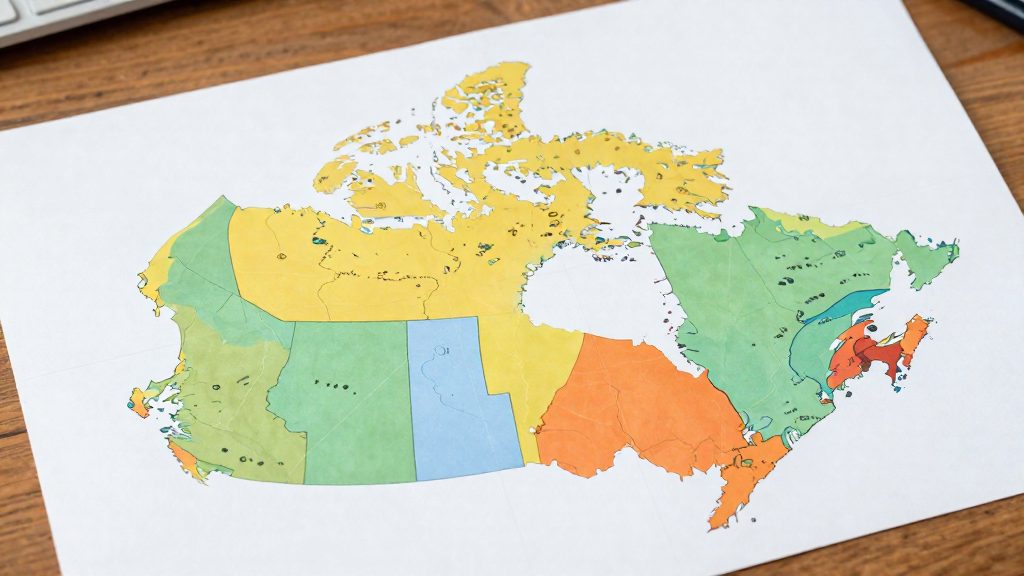
Canada’s national unemployment rate was 6.5% in June 2026, according to Statistics Canada (2026-07-10). Newfoundland and Labrador had the highest provincial rate at 8.2%, while Quebec and Manitoba tied for the lowest at 5.4%. The gap between the highest and lowest provincial rates was therefore 2.8 percentage points that month.
Unemployment rates by province, June 2026
The table below lists the ten provinces for June 2026, sorted from highest to lowest, based on Statistics Canada (2026-07-10).
| Province | Unemployment rate, June 2026 |
|---|---|
| Newfoundland and Labrador | 8.2% |
| Prince Edward Island | 7.6% |
| New Brunswick | 7.3% |
| Ontario | 7.0% |
| Alberta | 7.0% |
| Nova Scotia | 6.5% |
| British Columbia | 6.5% |
| Saskatchewan | 6.1% |
| Quebec | 5.4% |
| Manitoba | 5.4% |
Provincial rankings change over time. In June 2024, Newfoundland and Labrador was at 9.2% and Quebec at 5.7%, while British Columbia was at 5.2%, the lowest of those three figures. Ontario was at 7.0% that year, the same as in June 2026. Comparing rankings across two or three years shows which provinces have stayed high or low and which have moved.
The three territories are not directly comparable with the provinces. Statistics Canada reports their rates as three-month moving averages, so they are smoothed figures rather than single-month results. In June 2026, Nunavut stood at 11.6%, the Northwest Territories at 8.1% and Yukon at 7.3%.
When comparing provinces, check whether the figures are seasonally adjusted. Statistics Canada’s Labour Force Survey provincial tables are published with seasonal adjustment, which removes regular calendar patterns such as summer hiring. Using unadjusted figures against adjusted ones would distort the comparison.

Which provinces have the lowest unemployment?
In June 2026, Quebec and Manitoba recorded the lowest unemployment rates among the provinces, at 5.4% each, while Newfoundland and Labrador had the highest at 8.2%. The national rate that month was 6.5%, according to Statistics Canada (2026-07-10). Ranking provinces by a single month’s figure gives a snapshot, so check the trend before drawing conclusions about where unemployment is consistently low.
| Province | Unemployment rate, June 2026 |
|---|---|
| Quebec | 5.4% |
| Manitoba | 5.4% |
| Saskatchewan | 6.1% |
| Nova Scotia | 6.5% |
| British Columbia | 6.5% |
| Ontario | 7.0% |
| Alberta | 7.0% |
| New Brunswick | 7.3% |
| Prince Edward Island | 7.6% |
| Newfoundland and Labrador | 8.2% |
Source: Statistics Canada (2026-07-10).
The rankings change over time. In June 2024, British Columbia was at 5.2% and Quebec at 5.7%, against 6.5% and 5.4% respectively in June 2026. Newfoundland and Labrador was at 9.2% in June 2024 and 8.2% in June 2026. Statistics Canada (2024-07-05) reported these figures, but the official sources consulted do not specify provincial rates for the other provinces for that month in the same comparison.
Territories are not comparable with provinces. Their rates are three-month moving averages: Nunavut at 11.6%, the Northwest Territories at 8.1%, and Yukon at 7.3% in June 2026. Keep them in a separate group when comparing places.
Provincial ranking for June 2026 and how it shifts over time
Unemployment rates differ widely across Canada’s provinces, and the order can change within two years. In June 2026, Newfoundland and Labrador had the highest provincial rate at 8.2%, while Quebec and Manitoba were lowest at 5.4% each. The national rate was 6.5%, according to Statistics Canada (July 2026). The official sources consulted do not specify the causes behind these gaps, so the practical question for a comparison is whether two figures were measured in the same way.
Provincial ranking, June 2026
| Rank | Province | Unemployment rate |
|---|---|---|
| 1 | Newfoundland and Labrador | 8.2% |
| 2 | Prince Edward Island | 7.6% |
| 3 | New Brunswick | 7.3% |
| 4 | Ontario | 7.0% |
| 4 | Alberta | 7.0% |
| 6 | Nova Scotia | 6.5% |
| 6 | British Columbia | 6.5% |
| 8 | Saskatchewan | 6.1% |
| 9 | Quebec | 5.4% |
| 9 | Manitoba | 5.4% |
How the ranking shifts over time
In June 2024, the national rate was 6.4%. Four provinces can be compared across both years, according to Statistics Canada (July 2024):
| Province | June 2024 | June 2026 | Change |
|---|---|---|---|
| Newfoundland and Labrador | 9.2% | 8.2% | -1.0 points |
| Quebec | 5.7% | 5.4% | -0.3 points |
| Ontario | 7.0% | 7.0% | no change |
| British Columbia | 5.2% | 6.5% | +1.3 points |
British Columbia had the lowest rate of these four provinces in 2024 and was level with Nova Scotia at 6.5% in 2026. A single year’s ranking therefore says little about a province’s position over time.
Checking that two rates are comparable
- Seasonally adjusted figures from the Labour Force Survey (LFS) are the basis for the provincial tables 14-10-0287-02 and 14-10-0292-02.
- The three territories use three-month moving averages. Nunavut was at 11.6%, Yukon at 7.3%, and the Northwest Territories at 8.1% in June 2026. The source states these are not directly comparable with provincial rates.
- Always compare figures for the same reference month.
Territories: read these figures with caution
Statistics Canada publishes unemployment for the three territories separately from the ten provinces, and the two series are not directly comparable. According to Statistics Canada (2026), the territorial rates are three-month moving averages, which smooth out month-to-month swings. The provincial rates are monthly figures. In June 2026, the territorial rates were:
| Territory | Unemployment rate, June 2026 |
|---|---|
| Nunavut | 11.6% |
| Northwest Territories | 8.1% |
| Yukon | 7.3% |
Nunavut’s rate is above every province’s rate, the highest being Newfoundland and Labrador at 8.2%. The Northwest Territories and Yukon fall inside the provincial range of 5.4% to 8.2%. Placing them in a single ranking would overstate precision, because the calculation methods differ.
To compare locations more reliably:
- Match the period. Check that the territorial and provincial figures cover the same month and the same averaging method.
- Check the adjustment. Labour Force Survey data are seasonally adjusted. The provincial series are in Statistics Canada tables 14-10-0287-02 and 14-10-0292-02 (Statistics Canada, 2024).
- Compare trends, not single readings. The provincial order changes over time. In June 2024, Newfoundland and Labrador was at 9.2% and British Columbia at 5.2%. In June 2026, those figures were 8.2% and 6.5%, respectively (Statistics Canada, 2024; Statistics Canada, 2026).

How does Statistics Canada measure unemployment?
Statistics Canada publishes national and provincial unemployment rates from the Labour Force Survey (LFS). According to Statistics Canada (2026), the national rate was 6.5% in June 2026, and provincial rates ranged from 5.4% to 8.2%. Comparing these figures correctly depends on how the rate is calculated and which series are comparable.
What the rate measures
The unemployment rate is the number of people who are without work and actively looking for it, divided by the labour force, which is the employed plus the unemployed. People outside the labour force, such as students or retirees not seeking work, are excluded from the rate.
Series used for provincial comparison
- Seasonally adjusted data remove the regular monthly pattern, such as summer hiring, so that months can be compared directly. According to Statistics Canada (2024), the LFS provincial data are seasonally adjusted.
- The provincial tables are 14-10-0287-02 and 14-10-0292-02 (Statistics Canada, 2024).
- Territories are reported as three-month moving averages. Their June 2026 rates were Nunavut 11.6%, Northwest Territories 8.1%, and Yukon 7.3% (Statistics Canada, 2026).
How rankings shift between years
| Area | June 2024 | June 2026 |
|---|---|---|
| Canada | 6.4% | 6.5% |
| Newfoundland and Labrador | 9.2% | 8.2% |
| Quebec | 5.7% | 5.4% |
| Ontario | 7.0% | 7.0% |
| British Columbia | 5.2% | 6.5% |
Newfoundland and Labrador had the highest provincial rate in June 2026, but it was lower than in June 2024. British Columbia moved from 5.2% in June 2024, the lowest of the four provinces compared, to 6.5% in June 2026. The June 2024 comparison covers only these four provinces and the national rate.
Matching unemployment data with other indicators
Unemployment rates alone do not show whether a province is affordable or easy to settle in. Crossing them with housing and living-cost indicators requires matching time periods and methods. Statistics Canada’s June 2026 Labour Force Survey figures (July 2026) give a usable labour-market baseline.
The table below lists the June 2026 provincial rates, which are seasonally adjusted.
| Province | Unemployment rate, June 2026 |
|---|---|
| Newfoundland and Labrador | 8.2% |
| Prince Edward Island | 7.6% |
| New Brunswick | 7.3% |
| Ontario | 7.0% |
| Alberta | 7.0% |
| Nova Scotia | 6.5% |
| British Columbia | 6.5% |
| Saskatchewan | 6.1% |
| Quebec | 5.4% |
| Manitoba | 5.4% |
The national rate for the same month was 6.5%.
Match periods. Pair each unemployment figure with a housing price or rent series covering the same month or quarter. Rankings shift over time: in June 2024, Newfoundland and Labrador stood at 9.2% and Quebec at 5.7%, while British Columbia was at 5.2%. A single snapshot can therefore mislead.
Keep territories separate. The official sources consulted report Nunavut at 11.6%, Yukon at 7.3% and the Northwest Territories at 8.1% for June 2026. These are three-month moving averages and are not directly comparable with provincial rates, so they belong in a separate comparison.
Trace each figure to its table. Provincial series are published in Statistics Canada tables 14-10-0287-02 and 14-10-0292-02. Recording the table ID with each value makes the comparison verifiable.
Where to find official data
Statistics Canada is the official publisher of provincial unemployment rates, which come from its Labour Force Survey (LFS). According to Statistics Canada (2026), the national unemployment rate was 6.5% in June 2026, and the provincial rates for that month were published in the release dated 10 July 2026. The same agency’s earlier release of 5 July 2024 reported the June 2024 national rate at 6.4%.
Which tables to use
The provincial series sit in two Statistics Canada tables: 14-10-0287-02 and 14-10-0292-02. Search the agency’s website by table number rather than relying on secondary summaries. The LFS data are seasonally adjusted, so check the adjustment status before comparing figures from other sources.
June 2026 provincial rates
| Province | Unemployment rate (June 2026) |
|---|---|
| Newfoundland and Labrador | 8.2% |
| Prince Edward Island | 7.6% |
| New Brunswick | 7.3% |
| Ontario | 7.0% |
| Alberta | 7.0% |
| Nova Scotia | 6.5% |
| British Columbia | 6.5% |
| Saskatchewan | 6.1% |
| Quebec | 5.4% |
| Manitoba | 5.4% |
Source: Statistics Canada (2026).
Territories need separate handling
Territorial rates are three-month moving averages and are not directly comparable with provincial rates. For June 2026, Nunavut stood at 11.6%, the Northwest Territories at 8.1%, and Yukon at 7.3%. List them in a separate block or with a footnote, never in the same ranking as the ten provinces.
Compare the same month
Rankings shift over time. Between June 2024 and June 2026, Newfoundland and Labrador fell from 9.2% to 8.2%, Quebec from 5.7% to 5.4%, and British Columbia rose from 5.2% to 6.5%, while Ontario stayed at 7.0%. Always compare provinces on the same reference month, and state the month in any published comparison.
Frequently asked questions
Which province had the lowest unemployment rate in June 2026?
Quebec and Manitoba shared the lowest provincial rate at 5.4% each, according to Statistics Canada (2026-07-10). Both figures were below the national rate of 6.5% that month.
Can I compare the territories directly with the provinces?
No. Statistics Canada reports territorial rates as three-month moving averages, which smooth the data, so they are not directly comparable with single-month provincial figures. Nunavut’s 11.6% in June 2026 should be read as a separate benchmark, per Statistics Canada (2026-07-10).
Do provincial rankings stay the same from year to year?
No. In June 2024, Newfoundland and Labrador was at 9.2%, Quebec at 5.7% and British Columbia at 5.2%, which placed British Columbia lowest of those three, according to Statistics Canada (2024-07-05). Ontario’s rate of 7.0% was the same in both years, so checking several years shows which provincial rankings hold steady and which shift.